
Staying Online: A Guide to Availability Patterns
In the world of distributed systems, "down" is the four-letter word every engineer fears. Whether you're building a simple app or a massive microservices architecture, ensuring your service is reachable when users need it is paramount.
High Availability (HA) isn't just a buzzword; it's a design requirement. To achieve it, we primarily use two complementary patterns: Fail-over and Replication.
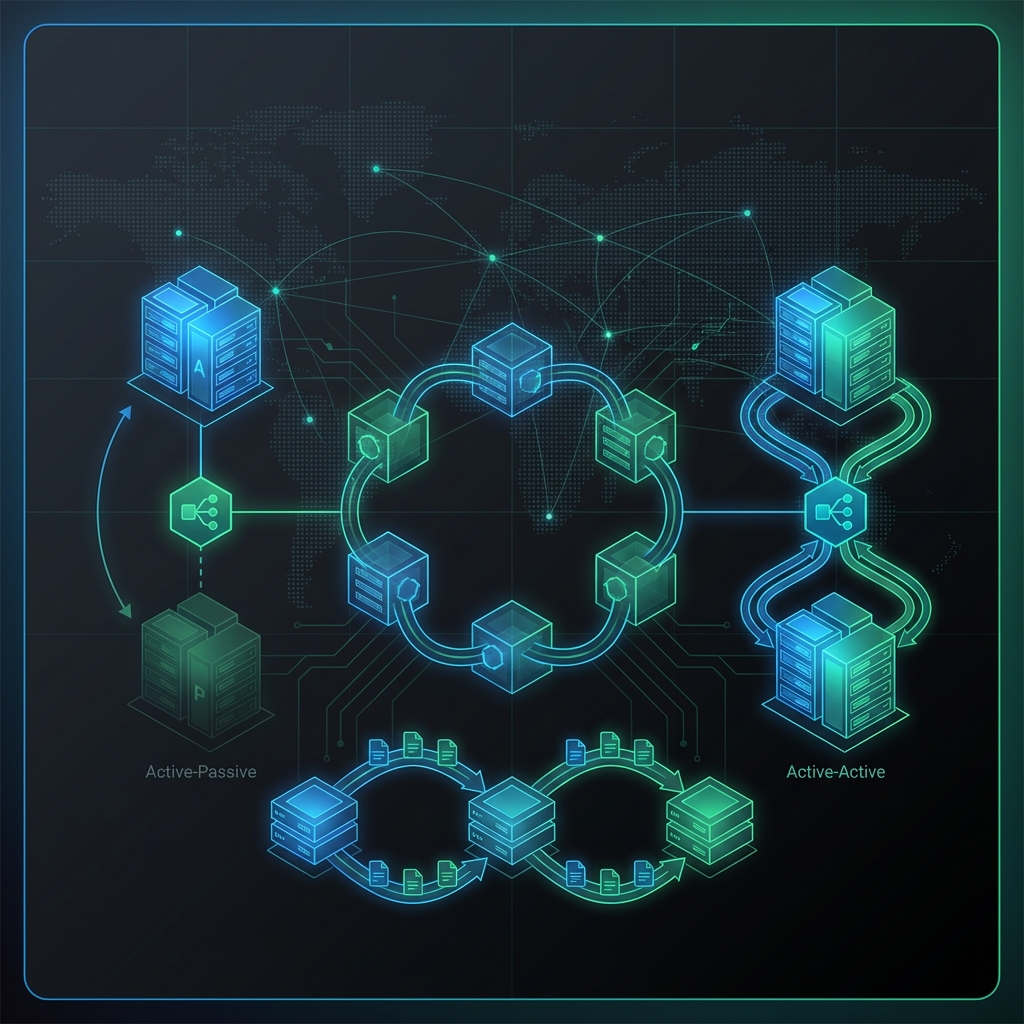
1. Fail-over Patterns
Fail-over is the process of automatically switching to a redundant or standby computer server, system, hardware component, or network upon the failure or abnormal termination of the previously active application, server, system, hardware component, or network.
Active-Passive (Master-Slave)
In an active-passive configuration, heartbeats are sent between the active server and the passive (standby) server. If the heartbeat is interrupted, the passive server assumes the active's IP address and resumes service.
- Hot Standby: The passive server is already running and ready to take over immediately.
- Cold Standby: The passive server needs to be started up before it can handle traffic, leading to longer downtime.
[!NOTE] Only the active server handles traffic. The passive server sits idle until a failure occurs.
Active-Active (Master-Master)
In an active-active setup, both servers manage traffic simultaneously, spreading the load between them.
- Public-facing: Use DNS Load Balancing (like Round Robin) to distribute traffic.
- Internal-facing: Application logic or an internal load balancer must be aware of both servers.
The Tradeoffs of Fail-over
While fail-over increases reliability, it comes with costs:
- Hardware Cost: You need at least double the hardware for the same capacity.
- Complexity: Managing heartbeats and state transitions is non-trivial.
- Potential Data Loss: If the active system fails before data is replicated, that data might be lost forever.
2. Replication Patterns
Replication involves copying data across multiple servers so that if one fails, the data remains accessible.
- Master-Slave Replication: One node (the Master) handles writes, while others (Slaves) replicate data from the Master and handle reads.
- Master-Master Replication: All nodes can handle both reads and writes, synchronizing data among themselves.
3. Availability in Numbers
Availability is quantified by uptime—the percentage of time a service is operational. We often talk about the "Number of 9s."
| Uptime % | "9s" | Yearly Downtime | Weekly Downtime |
|---|---|---|---|
| 99.9% | Three 9s | 8h 45min 57s | 10m 4.8s |
| 99.99% | Four 9s | 52min 35.7s | 1m 5s |
| 99.999% | Five 9s | 5min 15.6s | 6s |
4. Sequential vs. Parallel Availability
This is where the math gets interesting. How does adding components affect your overall uptime?
Components in Sequence (The Chain)
If your service requires everything to be up (e.g., Load Balancer → Web Server → Database), the overall availability decreases.
Formula: A(total) = A1 × A2 × ... × An
Example: If a Database (99.9%) and an API (99.9%) are in sequence: 0.999 × 0.999 = 0.998001 (99.8%)
Your system is now less available than its weakest link!
Components in Parallel (Redundancy)
If your system can function if either component is up (e.g., two servers behind a Load Balancer), the overall availability increases.
Formula: A(total) = 1 - (1 - A1) × (1 - A2)
Example: Two identical servers, each with 99.9% availability: 1 - (0.001 × 0.001) = 1 - 0.000001 = 0.999999 (99.9999%)
Redundancy turns three 9s into six 9s!
5. Real-World Use Cases
Scenario A: The E-commerce Checkout
Goal: Prevent double-spending and ensure stock accuracy. Pattern: Active-Passive Fail-over with Synchronous Replication. We prioritize consistency. If the master database fails, we fail over to a "Hot" passive node that is perfectly in sync.
Scenario B: Content Delivery Network (CDN)
Goal: Serve images and videos as fast as possible globally. Pattern: Active-Active Replication. If one edge server in London goes down, the DNS routes the user to another functional server in Paris. A small delay in updating an image across nodes is acceptable (Availability > Consistency).
Conclusion
Understanding these patterns allows you to make informed decisions about your architecture. Remember:
- Redundancy is the key to high availability.
- Parallel systems boost uptime; sequential systems drag it down.
- Choose the pattern that matches your application's risk profile and budget.
Are you designing for three 9s or five? The math will guide your architecture.